Is AI Worth It for a Small Business? An Honest Answer
What AI can actually do for a small business, where it won't help and whether you're too small to bother
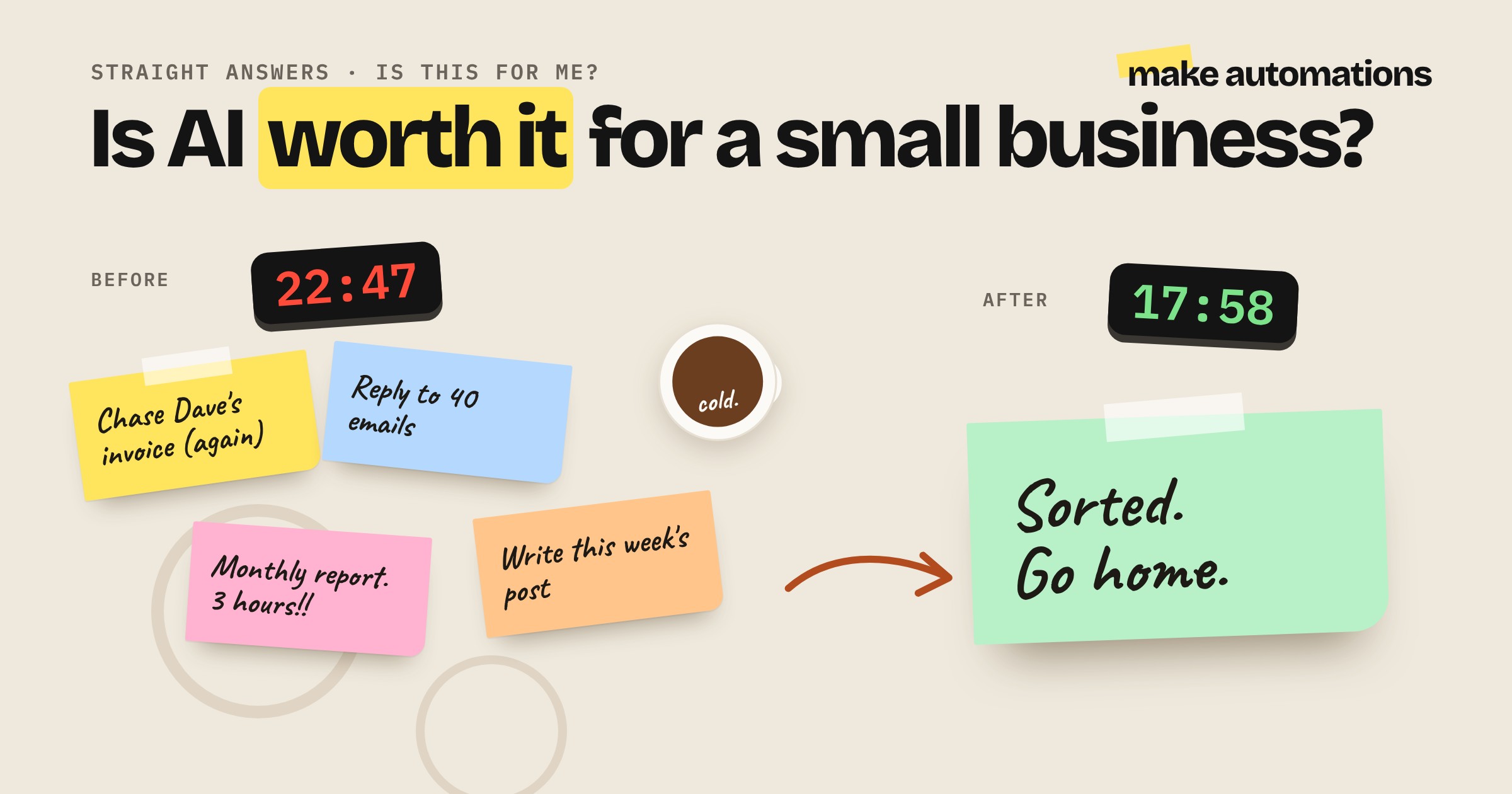
Before ChatGPT came along, a single LinkedIn post took me about two hours. I'd sit there staring at a blank screen thinking, right, now what? I run an engineering business that gets its work through word of mouth. I didn't start it to be a content creator.
So when people ask me whether AI is worth it for a small business, my answer is yes. But not in the way the hype suggests. It won't run your business for you. What it will do is take a lot of the admin off your plate so you can get on with the work you're actually good at.
Here's an honest look at where it pays off, where it doesn't and whether it's right for you.
What AI can actually do for a small business
Forget the robots. In practice, for a small business, AI is good at a handful of very useful things:
- Writing first drafts. Emails, quotes, proposals, social posts, newsletters. AI does the first version, you tweak it and send it.
- Replying to enquiries fast. Someone fills in your form, and a personalised reply is waiting in your drafts within minutes.
- Summarising. Long documents, meeting notes, a pile of reviews. AI pulls out what matters.
- Sorting and organising. Turning messy information into something useful, like tagging enquiries or sorting reviews by what they're about.
- Research. Looking up a company before a sales call, comparing suppliers, checking what competitors are up to.
- Answering questions. A chatbot that knows your business can deal with the common questions so you don't have to.
And when you connect AI to the tools you already use through automation, it does those things without you copying and pasting between apps.
What's the difference between AI and automation?
People use the words as if they mean the same thing, but they don't.
AI is the clever bit that writes, reads and makes judgement calls. ChatGPT, Claude and Gemini are AI.
Automation is the plumbing. It moves information between your tools and does the same steps in the same order every time. Make, Zapier and n8n are automation platforms.
The magic happens when you put them together. Using ChatGPT on its own is a good start, but it's a stepping stone. You're still copying and pasting. Connect it to your inbox, your CRM and your accounts with an automation and you never copy and paste anything again.
And not every automation needs AI. One of the most useful things I built for a client, a marketing agency, had no AI in it at all. It pulled live stats for every influencer in their database and cleaned up years of out-of-date records. It saved their team 10 to 15 hours, and it completely changed how they worked with brands.
Real examples of what it saves
Here's what that looks like in practice, from things I've built or run myself:
- A community support chatbot that freed up about 10 hours of support a week, with only a couple of percent of questions it couldn't answer.
- A review report that went through around 200 reviews in about 10 minutes, sorting them, drafting replies and pulling out what competitors were doing well and badly.
- Product listings that took about 10 minutes each by hand, down to about two.
- Our podcast. We drop the episode in a folder and the titles, descriptions, newsletter and LinkedIn post are drafted within a couple of minutes.
None of these are huge, complicated systems. They're small jobs that add up over a week.
Is my business too small for automation?
No. If anything, small is the advantage.
A big company that wants to automate something needs meetings, sign-off, an IT team and a budget. We're a small team, so we can have an idea in the morning and have the automation built, tested and running by the afternoon. Big companies can't move that fast.
You also don't need fancy software. If you've got a website form, an inbox and a spreadsheet, you've got enough to start. A Google Sheet is fine, any day of the week.
Will AI replace my staff?
I don't think it'll take the jobs of people already doing good work. What I do think is that, as small businesses grow, more of them will reach for AI before they hire for the admin roles.
The best approach is to arm the people you already have with AI. Let it do the heavy lifting, the copying, the first drafts and the chasing, while your team does the checking, the thinking and the talking to customers.
You'll always want a human in the loop. It just might be one person overseeing the robot rather than ten people doing the copy and pasting.
Where AI isn't worth it
This is the bit the hype leaves out. Half of good AI advice is knowing where it won't help.
- Jobs you only do once or twice a month. I once spent hours automating a booking system for one or two bookings a week. I could have just done them myself.
- Messy processes. If everyone does it differently every time, AI can't follow it either. Sort the process first.
- The human stuff. Customer complaints, closing a sale, hiring decisions and your relationships with clients. AI can do the research and the prep. It shouldn't be the one talking to the person.
- Anything you don't check. AI sounds confident even when it's wrong. Keep a human checking anything that goes to a customer.
Does AI actually save time?
It can, but there's a trap. Research has found that the time AI saves often gets filled with more work. I've been there. You've got AI working away in one tab, so you open another one and start something else. Before you know it, you're working later, not earlier.
The fix is to be deliberate about it. Chat tools like ChatGPT need you sat there watching them. Automations don't. They run in the background while you get on with your day, or while you go home.
So use the time you save on purpose. Otherwise it disappears.
Is it too late to get into AI?
Not at all. This isn't like Bitcoin, where you missed out on buying it for a penny. AI moves so fast that someone starting today can catch up with someone who's been at it for years.
And if you're worried you're only scratching the surface, don't be. Almost nobody uses AI anywhere near its full capacity, me included. Using it for the repetitive basics already puts you miles ahead of most business owners.
What it costs to start
Very little. You can try ChatGPT, Gemini and Make on their free plans before spending anything. When you're ready, the main paid AI plans are around $20 a month, and Make's Core plan is about $9 a month billed yearly. The real cost is your time to learn it, and that's less than you'd think.
My advice
Try it on one job this week. Pick the admin task that annoys you most, the one you leave until 10pm, and see if AI can draft it or an automation can do it for you.
If it saves you time, do the next one. If it doesn't, you've lost an afternoon and learned something.
Questions people also ask
Is AI worth it for a small business?
For most small businesses, yes, if it's used on the right jobs. The biggest wins come from repetitive admin like replying to enquiries, chasing invoices, writing first drafts and moving information between tools. It's cheap to start and you don't need to be technical.
What can AI actually do for a small business?
Write first drafts of emails, quotes and posts, reply to enquiries quickly, summarise documents and meetings, sort and organise information, do research and answer common customer questions through a chatbot. Connected to your tools with automation, it does this without copying and pasting.
What's the difference between AI and automation?
AI is the part that writes, reads and makes judgement calls, like ChatGPT or Claude. Automation moves information between your tools and follows the same steps every time, like Make or Zapier. Together they handle whole jobs for you.
Is my business too small for automation?
No. Small businesses have the advantage because they can try something in the morning and have it running by the afternoon. You only need what you already use, like a website form, an inbox and a spreadsheet.
Will AI replace my staff?
It's unlikely to replace people already doing good work. The best approach is to give your existing team AI tools so they spend less time on copy and paste admin and more time on the work that needs a human.
What are the risks of using AI in my business?
The main ones are putting confidential data into the wrong tools, AI getting facts wrong in customer-facing work and relying on AI for jobs that need a human. Keep customer data out of personal chat accounts and have a person check anything that goes to a customer.
Is it too late to start using AI?
No. AI moves so fast that someone starting today can catch up quickly. Using it for the basics already puts you ahead of most small businesses.