AI for Recruitment Agencies: What to Automate and What to Keep Human
Where AI and automation genuinely save a UK recruitment agency time, what the ICO now expects when you use them on candidates, and how to set it up without auto-rejecting your best placement
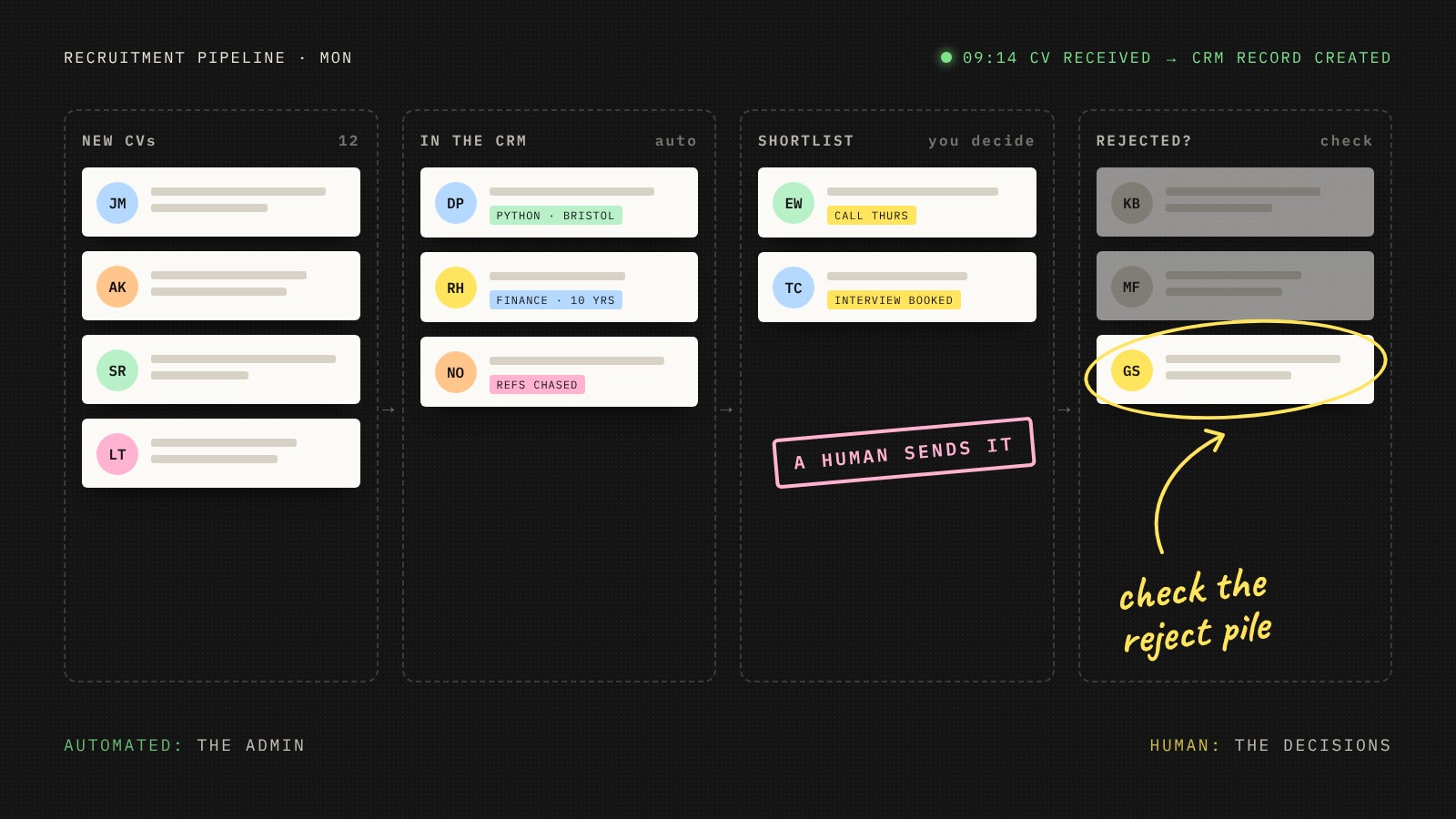
Recruitment is a margin game. Every hour a consultant spends retyping a CV into the CRM, chasing a candidate for references or writing the same client update again is an hour they're not on the phone.
That's exactly the work automation is good at. The bit to be careful with is the bit everyone gets excited about first: letting AI decide who gets through.
Where AI genuinely helps an agency
- CVs into the CRM. A CV lands in the inbox, gets read, and a candidate record is created or updated with the key details. No retyping.
- Searching your own database properly. Ask in plain English and get the right CVs back, rather than hoping you guessed the right keywords.
- Job ads. A first draft from the client brief, in your agency's tone, ready for a consultant to tidy and post.
- Candidate chasing. Reminders for missing documents, references and right-to-work checks, sent on time without anyone having to remember.
- Client updates. A weekly status per open role pulled from the CRM and sitting in drafts, ready to check and send.
- Interview admin. Booking, confirmations and reminders, so nobody misses an interview because an email got buried.
- Call notes. A call turned into a tidy note on the candidate record with the next steps pulled out.
Most of that is automation, not AI agents. Same thing in, same thing out, every time. AI sits inside the steps that need reading or writing, and a person checks what goes out.
The keyword problem
I was once showing AI agents to a recruitment agency. They said they already had an agent, they'd given it all these keywords, but if they hadn't got the keywords right it found nothing.
So I got my Telegram bot out, which had a load of CVs loaded in, and asked it: could you find me someone in Bristol who's a Python developer with about 10 years' experience? It came back with the right CVs. Then I asked it to send an email to Jeff. It wrote it and put it in my drafts.
They were blown away. No keywords. I'd just asked it like I'd ask anyone on the team.
That's the real win for an agency. Your database is probably your most valuable asset, and most of it is sitting there because it's a pain to search.
What the ICO now expects
AI on candidates means personal data, and the regulator has been paying close attention.
In 2024 the ICO audited several providers of AI recruitment tools and made almost 300 recommendations. It found some tools let recruiters filter out candidates with certain protected characteristics.
In March 2026 it followed up with a report on automated decision-making in recruitment, after working with more than 30 employers. It found gaps in transparency, safeguards, human involvement and bias monitoring. A lot of employers described their tools as "decision support", but in practice there often wasn't any meaningful human involvement.
The Data (Use and Access) Act has loosened the rules on automated decisions, but the ICO still expects safeguards when you use them:
- Tell candidates when automated decisions are being made and how they work.
- Explain how they can challenge a decision and get a human to review it.
- Make human involvement consistent, not a rubber stamp.
- Test the outputs for bias regularly, and ask suppliers how they test theirs.
We're not lawyers, so get proper advice on your own setup. But the practical takeaway is simple: if a person genuinely reviews every shortlist and every rejection, you're in a much better place.
Check the reject pile
Let AI sift applications, by all means. Just look through the ones it rejected.
I was put on a reject pile myself once, by a human, and only got the interview because a friend flagged my application. I got the job. There might be a diamond in the rough in there, and it could be your next placement.
The things I'd keep human in any agency:
- Rejections. AI can suggest, a consultant decides.
- Interviews. No AI interview bots. Talking to the person is the job.
- Client relationships. The call when a placement falls through is yours.
- Anything a candidate reads. It lands in drafts and a person sends it.
Just because you can automate something doesn't mean you should.
How we set it up for an agency
- Map the admin. We look at where your consultants' time actually goes and pick the jobs worth automating first.
- Connect what you already use. Your inbox, CRM, calendar and job boards wired together in Make. If your CRM has an API, Make can usually talk to it. We check yours before quoting anything.
- Claude for the writing. Job ads, client updates and call notes in your agency's voice, set up as Claude Projects so every consultant gets the same quality.
- A human step built in. Shortlists and anything going to a candidate or client stop for a person to check.
- Everything in your accounts. You own the automations and the data, so you're not tied to us.
Most agencies start with a 45-minute session (£150) to work out which jobs to tackle first. Builds start from £800, and a Claude Business Setup for the team is £795.
Questions people also ask
How can recruitment agencies use AI?
The biggest time savings are in admin: getting CVs into the CRM, searching your candidate database in plain English, drafting job ads, chasing candidates for documents, booking interviews and writing client updates. Keep a person checking anything that goes to a candidate or client.
Is it legal to use AI to screen CVs in the UK?
It can be, but data protection law applies. The ICO expects you to tell candidates when automated decisions are made, let them challenge a decision and get a human review, keep human involvement meaningful and monitor for bias. Take proper legal advice on your own setup.
Should AI reject candidates automatically?
We don't recommend it. Let AI sort and suggest, then have a consultant review the shortlist and the rejections. Good candidates get missed by filters, and the ICO has found many tools described as decision support were making decisions with little real human involvement.
What's the difference between recruitment automation and AI recruitment software?
Recruitment software is a product you buy and fit your process around. Automation connects the tools you already use, like your inbox, CRM and calendar, so the admin happens between them. It's worth seeing what you can automate with what you already have before buying something new.
How much does recruitment automation cost?
At Make Automations, builds start from £800 and a 45-minute session to work out where to start is £150. You own the automations and the data.
Will AI replace recruitment consultants?
Not the good ones. AI is good at the admin around recruitment. Reading people, managing clients and closing placements is still the job, and it's the bit candidates and clients are paying for.